
What are OPUS™ AFM probes?
This article provides information about the origins of OPUS™ AFM probes, the technological background and the similarities between OPUS™ AFM probes and now discontinued Olympus* AFM probes, as well as the history of SOI AFM probes in general.
The Silicon On Insulator AFM Probe - Past, Present and Future.
The first AFM probe, in the original paper by Binning, Quate and Gerber in 1986, consisted of a hand assembled gold foil with a diamond piece glued at the tip. In 1989 came the first process capable of mass-producing an AFM probe, by Akamine and Quate at Stanford. Their approach consisted of defining a tetrahedral silicon tip, on a silicon nitride cantilever, through a succession of lithography, deposition and wet etching of a pure silicon wafer. A further improvement in sharpness came from a team in IBM Sindelfingen, consisting of Wolter, Bayer and Greschner, who discovered in 1991 that anisotropic wet etching of Si by aqueous KOH can lead to the production of self-terminating, atomically smooth AFM tip geometry.
These two processes rely on deposition (in the Akamine/Quate case) or etch timing (in the case of the KOH Wolter wet etch of Si). This requires tight control of timing to achieve the desired thickness.
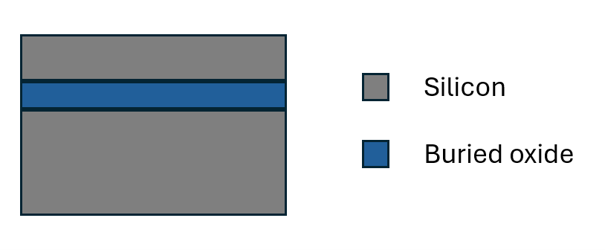
Figure 1 Cross-section of an SOI wafer.
In 1995, Katsuhiro Matsuyama, at Olympus* Optical Co. Ltd, Japan, patented a process relying on a Silicon-on-Insulator (SOI) wafer as a starting substrate. In an SOI wafer, a thin oxide layer is buried at a tightly controlled depth below the surface. While originally developed as a solution for different problems associated with reducing transistor size in microelectronics, these wafers provided a means to mass-produce cantilevers at consistent thickness by relying on the buried oxide as an etch stop. Coupled with improvements in deep reactive ion-etching (DRIE), this also permitted combining a tetrahedral AFM tip with a silicon cantilever. Additionally, the use of buried oxide etch stop allowed for a much smoother and reflective backside of the cantilever.
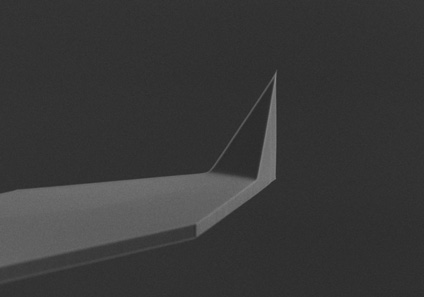
Figure 2 Example OPUS™ AFM tip.
In 2016 OPUS™ was launched by MikroMasch® as a brand of SOI-based cantilevers with optimized AFM tip positioning, following the original Stanford/Olympus-developed fabrication process. Having made a choice to remain uncompromising on probe quality, nowadays, with the discontinuation of Olympus* probes in 2022, we are the only AFM probes manufacturer worldwide using the time-tested original process.
The SOI Architecture - Why It Was a Breakthrough
SOI wafers consist of:- A precisely defined silicon device layer
- A buried oxide layer acting as an etch stop
- A mechanically robust silicon handle wafer
This architecture solved several critical problems in early AFM probe production: reproducibility in cantilever thickness, improved cantilever reflectivity and made the optimally-positioned tetrahedral AFM tips compatible with silicon cantilevers. The device layer thickness determines spring constant, resonance frequency, and mechanical stability. Because the thickness is defined at the wafer level, cantilevers fabricated from SOI show high mechanical uniformity across entire batches. The buried oxide enables highly controlled micro machining and reproducible cantilever release, improving yield, backside smoothness and dimensional accuracy. This directly benefits AFM users, by allowing for better spring constant reproducibility, force constant and AFM tip geometry, which ultimately leads to more reproducible results and less experimental uncertainty. The reduced roughness increased cantilever reflectivity, allowing higher signal to noise ratios and better imaging results for users. The smoother underlying surface is also beneficial to reflectance when the cantilever is coated. The tetrahedral AFM tip allows for tips to be positioned above the sample, with no tip setback, facilitating accurate, first-time-right positioning from the microscope video-feed. Having it on a silicon cantilever provides it with all of the reproducibility and reliability benefits of silicon cantilevers compared.
The OPUS™ Platform - from 2016 until today
Since 2016 we have worked to expand the selection of OPUS™ probes to include a wide range of cantilever types, covering standard applications, such as tapping and contact mode, as well as recent techniques, such as high-frequency AFM. We also offer coated probes for electrical and magnetic measurements, high-aspect ratio probes with carbon fiber and diamond-like spikes, as well as gold-coated probes.
The future of OPUS™
At OPUS™, we are constantly working on new types of AFM probes to complement our portfolio.
We remain committed to offering the widest portfolio of SOI AFM tips worldwide, with the most reliable and consistent quality on the market, anywhere in the world.
Make sure to check our website on a regular basis to stay informed about our latest developments.
For further questions, please contact us at info@opustips.com
*Olympus® is a trademark of Olympus Corporation